Global Medieval Pilgrimage

A Pilgrimage through the Global Middle Ages

Welcome, fellow pilgrim!

Whether you’re traveling for contemplation, worship, healing or the thrill of a new encounter, you’ve come to the right place.

Popular concepts of the Middle Ages—think Game of Thrones—draw on limited, mostly European, models of the world between 500 and 1500. The Global Middle Ages movement, on which there is substantial scholarship, expands our idea of the Middle Ages to celebrate the breadth of cultural, religious and social interchange that characterized the entire world between 500 and 1500.

  • Explore the Meaning of Pilgrimage: Experience aspects of a pilgrimage and reflect on its significance as a deeply human, embodied activity!

  • Understand History’s Context: Investigate how people’s views of the history they experience are shaped by their context (the social, cultural, economic, and political norms that they don’t control), and how how modern assumptions can influence our understanding of that historical context.

  • Develop Critical Historical Skills: Carefully evaluate primary historical sources written/created/produced by people in the past, analyze those sources in their historical context to look for missing information, and actively seek out new perspectives in the secondary sources produced by modern historians about primary sources to enrich your understanding of the past.

  • Challenge Traditional Assumptions: Use modern tools to question outdated ideas about what actually was “medieval”, which parts of what we think of as “medieval” were created by early-modern and Victorian scholars, and understand the difference applications of “medieval” in both its historical context and in the modern world.

1. Travel a Forested Path

Author: Morten Oxenboell, East Asian Languages and Cultures, Indiana University

Rain or shine, people find refuge in these tree-lined labyrinthine paths. Whether they observe the nature of beauty in isolation or seek the spiritual company of fellow travelers, each pilgrim crosses a boundary from the bustle of the outside world into a quiet, contemplative forested preserve.

Need a location clue?

Find me in the shade of a gazebo overlooking a pond, hidden by the shade of a treelined path that’s almost, but not quite, on campus.

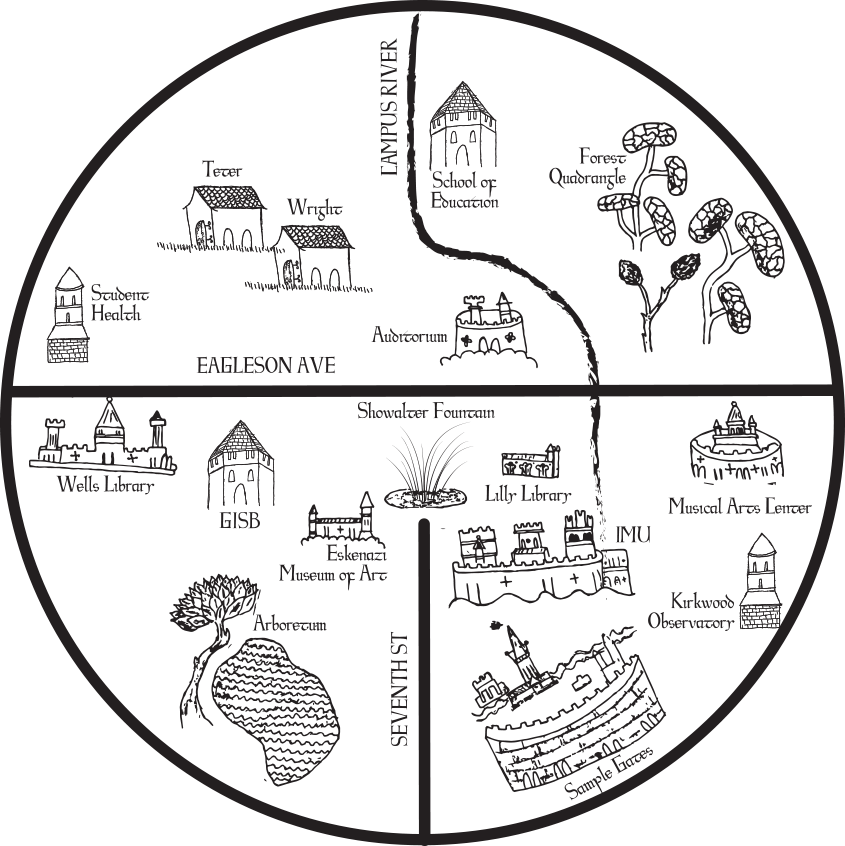
Open location in map
The medieval parallel

Shikoku Henro

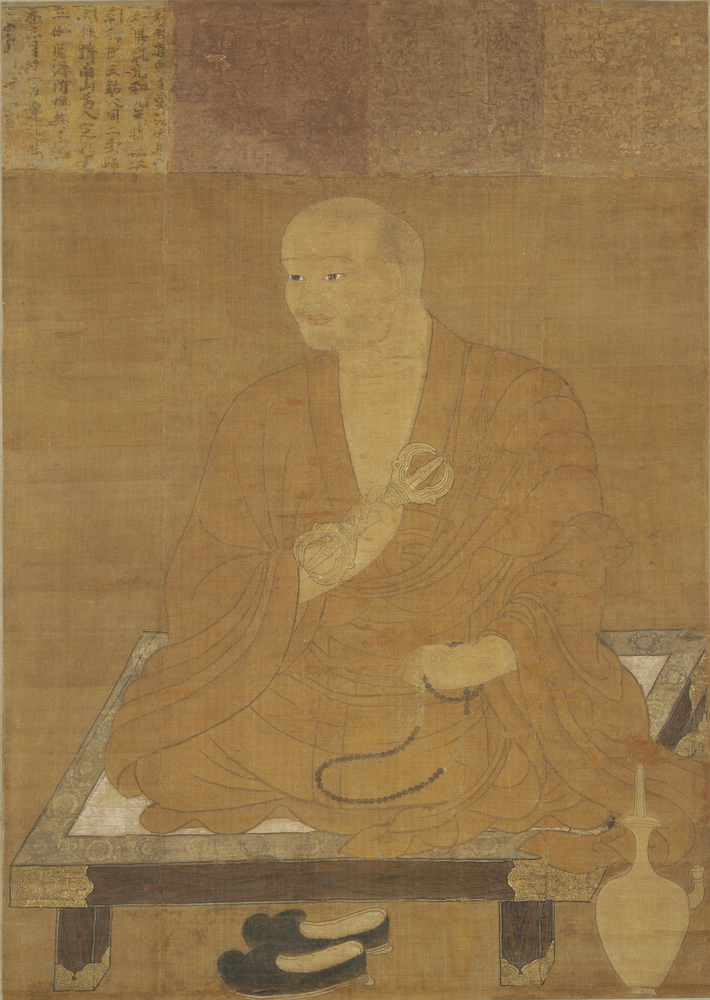
The Shikoku Henro, or Shikoku pilgrimage, is a circular pilgrimage to 88 sites on the Japanese island of Shikoku. It’s associated with the life and travels of Kūkai, a Buddhist priest who was born Saeki no Mao (Mao, of the Saeki family) on Shikoku in the 9th century. Kūkai’s early studies led him to a life of ascetic and meditative practices as a Buddhist and an administrator in 9th century Japan. His writings on Buddhism in the Japanese tradition led to his other name, Kōbō Daishi, or “Great Teacher”.

Much of the path for the temples in the middle fo is forested and offers contemplation of both the natural world and Kūkai’s Buddhist teachings. A collection of folksongs from 12th-century Japan, the Ryojin Hisho, mentions the Shikoku pilgrimage among a number of other pilgrimages. One poem laments the winter pilgrimage and the trees that lose their leaves:

The mountain ascetic suffers the austerity of winter: his house of trees has lost. (RH 305)

By the 16th century, 88 specific sites had emerged as a pilgrimage tradition that lives on today.

  • Kim, Yung-Hee. Songs to Make the Dust Dance: The Ryojin Hisho of Twelfth-Century Japan. Berkeley, CA: University of California Press, 1994. http://ark.cdlib.org/ark:/13030/ft2f59n7x0/
Open medieval map location

2. Seek a Wise Counselor

Author: Nicolò Sassi, Theological Studies, St. Louis University

Students seek wisdom from people well trained in the studia humanitatis (the humanities). Such counselors can offer guidance as students explore new subjects and interesting classes. A single building contains two of these esteemeed counselors, one for Medieval Studies in the three hundred and fourteenth room and one for history in the three hundred and ninth room.

Need a location clue?

Find me between Lincoln Hall and the Main Library

Open location in map
The medieval parallel

John Moschos' _Spiritual Meadow_

Between the end of the sixth and the beginning of the seventh century, Byzantine monk John Moschos and his friend Sophronius undertook a long pilgrimage to meet the ascetics and wise men of the Eastern Christian world. Their last stop was the monastery of Deir ul-Muharraq.

Travelling from Syria through the deserts of Palestine, Egypt, and Libya, John and Sophronius encountered many monks and hermits who offered them wisdom in the form of stories. John recorded all these stories — from the adventurous to the hilarious to the awe-inspiring and thought-provoking — in a rich collection describing his travels called Spiritual Meadow:

Someone among the fathers told that one of the elderly ones, who was pure and saint, when he “did the proskomide” (i.e. celebrated Mass) saw angels staying at his right and at his left. He had taken over the “proskomide” from the heretics, and since he was ignorant about divine doctrines, he said the words of the offering in simplicity and innocence, not knowing that he was wrong. By providence, some brother, an expert in divine doctrines visited him. It came to pass that the old man made the offering in his presence. The brother said to him (he was a deacon): The words you said for the proskomide, Father, are not of the orthodox faith, but of the bad doctrine. The old one, since he saw angels during the offering, did not pay attention to what was said, but disdained it. The deacon insisted saying “You are in error, good old one, the Church does not accept this”. The old man, seeing that he was accused and blamed in that way by the deacon, saw the angels as usual and asked them: “Since that deacon talks to me in such a way, what is it that he says?” The angels said: “Listen to him: he says the truth”. The old one said to them: “And why did not you tell me that?” They said to him: “Because God disposed thus, that humans should be corrected by humans”. And since then he corrected himself and thanked God and the brother.

Open medieval map location

3. Join a Festival of Nations

Author: Sean Purcell and Kalani Craig, University of California San Francisco Libraries; Department of History, University of Illinois Urbana-Champaign

Students, visitors, and staff meet at these sculpted grasslands to enjoy performances together, celebrate holidays, and enact communal rituals. Because of the location right in the middle of everything, this site is home to many different people at different times of the year, and open to all who may pass through.

Need a location clue?

Find me on the grassy quad at the center of everything.

Open location in map
The medieval parallel

Cahokia Mounds

The Cahokia Mounds, located in the Bottom Region (near Collinsville, Illinois, in the Mississippian Southeast region of the United States), was home to one of the greatest cities in the world. The Cahokia urban area served as a gathering place for a vast community of indigenous Native Americans from the 8th to the 14th century and, at its peak between 1000 and 1200 C.E., was larger than contemporary London. Cahokia served as a home, and as a ritual and festival ground, for 20,000 people. Crowds filled its Grand Plaza and visitors marked the winter and summer solstice at Cahokia’s Woodhenge, an installation designed for astronomical observation.

Its largest earthen structure, Monks Mound, is roughly the size of the Great Pyramid at Giza, covering 15 acres at its base (a larger area than Dunn Meadow). Equally impressive are the new forms of material culture — including new pottery forms and markedly new uses for those new pottery forms — that resulted from Cahokia’s development into a central gathering space for people from many Native American nations. Examples of Cahokian pottery have been found all across the middle of North America, from the upper Midwest to the lower South, suggesting the importance of Cahokia as both a gathering destination for, and an influence on, a huge swath of North America.

Open medieval map location

4. Falling Waters Mark a Festival and the Start of a Pilgrimage

A cascade of water often marks the site of a joint festival and pilgrimage site. Bonus: there’s almost always a marketplace with food stalls and fun activities nearby!

Need a location clue?

A famous huntress, with her arrow and several companion nymphs, crowns this fountain that’s not far from a bustling center of food and gathering that attracts locals and visitors alike.

Open location in map
The medieval parallel

Kumano Sanzan, or the Three Mountains of Kumano

Nachi 那智, on the southern end of the Kii peninsula in Wakayama prefecture in Japan, is a waterfall and sprawling shrine-and-temple complex that features on not one, but two pilgrimages:

  • The Kumano Sanzan/Three Mountains of Kumano. These “mountains” are widely known by the names of their shrines, which are, in turn, part of a broader pilgrimage site called “Sacred Sites and Pilgrimage Routes of the Kii Mountain Range” that was designated a world-heritage site in 2004. Aristocrats and royals living in the capital Heian (now Kyoto) started going on pilgrimage to the area in the second half of the 11th century, and it has drawn pilgrims ever since. Although the complex fell into disrepair and had fewer visitors in the 20th century, the world-heritage designation has encouraged a revival of pilgrimages on the mountain trails.
  • The Saigoku Kannon / Western Kannon pilgrimage route. Thirty-three (33!) temples enshrine manifestations of the bodhisattva of mercy, Kannon (Skt. Avalokiteśvara, Perceiver of the Cries of the World). Seigantoji, the Buddhist temple at Nachi, is the first stop on the itinerary. While pilgrimages on this route began later than on the Kumano route, it’s still very active today.

Photos of the waterfall and surrounding shrines at the Kumano Kodo official site offer a glimpse of its beauty, and pilgrims both medieval and modern collect stamp-talismans at each shrine.

The Nachi shrines saw several different periods of historical activity:

  • Initial pilgrimages began ca. 1050
  • A period of intense pilgrimage activity between 1100 and 1570

Like Nachi, Showalter Fountain has an iconic water feature and is built for a walk-by and a longer visit. It’s common to hold festivals on shrine or temple grounds in Japan, and there’s always a market attached to them, so it makes (Japanese) sense to have a festival around a pilgrimage site. Showalter also has three different buildings facing it that match with the modern and contemporary organizational structure at the Nachi site. The core feature at Nachi is the waterfall, but there are three distinct religious institutions located around it:

  1. Nachi Taisha, located at the end of the traditional approach, which is a hike along a cedar-lined path from the area where the paddy-fields above the town of Nachi end. The IU Auditorium at the end of the circular drive around Showalter is a good parallel.
  2. Seigantoji (Buddhist) next to Nachi Taisha are located on a broad ledge above the waterfall. The iconic pagoda that’s often photographed with the waterfall belongs to Seigantoji, in much the same way that the Lilly Library is often a backdrop for photos of the Showalter Fountain.
  3. Hiro Shrine (Shinto), at the bottom of the waterfall anchors the plaza, like the Fine Arts Building and Eskenazi Museum of Art.

Different areas and organizations jockeyed for influence from the beginning, but this clear division — both between institutions but especially between Buddhism and Shinto — is distinctly modern.

Open medieval map location

5. Venture into the Depths of Mother Earth

Author: Russell Valentino, Slavic and East European Languages and Cultures, Indiana University

The largest building in this cluster just celebrated its 100th year of hosting showy sports events, but if you look behind the spectacle, you’ll find a system of interlinking tunnels and caverns down below that are even more labyrinthine. Be careful! One wrong turn and you never know where you’ll end up….

Need a location clue?

Find me where the gymnastics and volleyball teams compete and then look across the street to see a housing complex that’s connected by now-derelict tunnels.

Open location in map
The medieval parallel

Kyiv-Pechersk Lavra, 'Monastery of the Caves'

The Kyiv-Pechersk Lavra, or “Monastery of the Caves,” founded by the legendary monk Antony, is comprised of a number of structures (churches, bell towers) and a system of narrow underground caverns and passageways that pre-date their use as an Eastern Orthodox site of worship. They have been associated with old Slavic beliefs in the powers of the “moist Mother Earth.” The entire place is extremely bright and showy on the outside and rather claustrophobic on the underground inside.

Open medieval map location

6. Visit a famous healer

Author: Kalani Craig, Department of History, University of Illinois Urbana-Champaign

The student community flocks here for the laying on of hands. Holy men and women cure minor chronic illnesses like fevers and joint pain as well as acute illnesses and serious injuries, but it’s quite a hike and you have to get past the keeper of the shrine first.

Need a location clue?

Find me where students go to get doctor’s notes for class when they don’t have a doctor off campus.

Open location in map
The medieval parallel

The Shrine of St. Martin of Tours (47.3946308,-38.3422852) Late 6th-century pilgrims from all over the Mediterranean came to a small shrine in Tours (what is now France) to heal their chronic and acute illnesses at the Shrine of St. Martin. Gregory of Tours, Bishop of St. Martin and author of a number of St. Martin’s miracle stories, was himself healed through prayer at the tomb of St. Martin. He writes about it in The Four Books of the Miracles of St. Martin

Whenever headache comes on or a throbbing in the temples or a dulness of hearing or a dimness of sight or a pain attacks some other part, I am cured at once when I have touched the affected part on the tomb or the curtain hanging before it and I wonder within myself that at the very touch the pain is immediately gone. I shall place first in this book a miracle that I experienced recently. We were sitting at dinner after a fast and eating, when a fish was served. The sign of the cross of the Lord was made over it, but as we ate, a bone from this very fish stuck in my throat most painfully. It caused me great distress, for the point was fastened in my throat and its length blocked the passage. It prevented my speaking and kept the saliva which comes frequently from the palate, from passing. On the third day, when I could get rid of it neither by coughing or hawking, I resorted to my usual resource. I went to the tomb and prostrated myself on the pavement and wept abundantly and groaned and begged the confessor’s aid. Then I rose and touched the full length of my throat and all my head with the curtain. I was immediately cured and before leaving the holy threshold I was rid of all uneasiness. What became of the unlucky bone I do not know. I did not cough it up nor feel it go down into my stomach. One thing only I know, that I so quickly perceived that I was cured that I thought that some one had put in his hand and pulled out the bone that hurt my throat. (Book 3; Preface & Chap 1) The skull of St. Martin (courtesy of Wikimedia Commons)
Virtual Medieval Pilgrimage by Kalani Craig, 2025 - 2026. DigitalArc Jekyll Theme by Kalani Craig is licensed under CC BY-NC-SA 4.0 Framework: Foundation 6.